
At a glance
- This page is for a company that already exists and already earns. Not for a first-time founder, the questions are different and so are the obstacles.
- The capital is rarely your problem. The compliance file is. A foreign corporate shareholder is a heavier onboarding case for a German bank than a private individual, not a lighter one.
- Beneficial ownership has to be traced through your group and notified to the German transparency register. Where the chain runs through several Indian entities, that takes longer than anybody plans for.
- Transferring your own manager runs on the ICT Card under § 19 AufenthG. It requires six months' prior group membership and it expires after three years. Neither is negotiable.
- We are in Reutlingen, in the Stuttgart region, inside the supplier landscape most Indian companies are actually trying to reach.
Who this is for
Most writing about setting up in Germany is addressed to founders. If you are the export head, the CFO or the country manager of a company that has been trading for fifteen years, almost none of it is about you.
You are not raising capital, you are allocating it. You are not testing whether the business works, you already know. You have a board that wants a timeline, an auditor who will ask how the German entity consolidates, and a parent company whose documents nobody in Germany has ever seen. Your obstacles are the ones a founder never meets.
That is the situation this page is written for.
Subsidiary, branch or neither
The first decision is which structure, and it is usually made too quickly on the assumption that a branch is the lighter option. It generally is not: § 325a HGB requires a German branch to publish the parent company's accounts in Germany, the parent remains fully liable for the branch's obligations, and the apostilled document chain is the same either way. What that chain contains, and the order to do it in, is set out in Documents for a German company from India.
We set the comparison out properly, with the provisions, in Subsidiary or branch office?, including where a branch genuinely is the right answer, and where an Employer of Record is enough for now.
Most groups that come to us end up with a GmbH. The reasons are consistent: the parent's figures stay private, the exposure is ring-fenced, and German customers, banks and landlords deal more easily with a German legal person than with the German branch of a foreign one.
What actually has to happen
In the order it has to happen, which is not the order most plans assume.
- The parent's documents. Register extract, articles, evidence of who may represent the company, and a board resolution authorising the German entity. Certified, apostilled through the Ministry of External Affairs, translated by a sworn translator. Two to four weeks on a good run, start on day one.
- Getting the originals to Germany. This step is missing from every timetable we have seen, and it is not free. The register court and the notary need original apostilled documents, not scans, so the file has to travel physically from India by international courier. Budget for the courier charge, allow several days on top of the apostille itself, use a tracked service, and keep certified copies of everything before it leaves, if a set is lost in transit, the whole certification chain starts again from the beginning.
- The banking route, settled before the notary. Not after. Which bank will onboard a company in formation whose shareholder is a foreign corporation is a question with a small number of answers, and finding out late costs weeks.
- Name check and articles. The chamber of commerce will say whether the name works; the articles decide the managing director's authority, which your board will want to look at.
- Notarisation. Our notary normally holds the appointment in English and draws the documents in German and English, so in most cases no interpreter is needed, and nobody has to fly in where a power of attorney is accepted. Both remain the notary’s decision in each case.
- Capital, then filing, then the register number. In that order, the German sequence runs the opposite way to the Indian one, which is worth reading about in the bank article before you instruct the transfer.
- Transparency register, trade registration, tax office. Beneficial ownership notified, the trade registered, the tax questionnaire filed, the tax number and the VAT identification number obtained.
- If goods are moving: the EORI number. Before the first shipment leaves, not when it is at the port.
- If you will employ: the employer registrations. A company number from the Federal Employment Agency, membership of the competent trade association, compliant payroll. The detail is in hiring employees in Germany.
What is harder for a corporate parent
Three things surprise groups who assumed their size would make this easier.
The bank reads a corporate shareholder as a bigger file, not a smaller one
An individual founder has one identity to verify. A corporate shareholder means the bank has to understand the ownership chain, identify the beneficial owners behind it, and satisfy itself about the source of the funds, for a company incorporated under a legal system its compliance team does not work with daily. A strong balance sheet helps with the credit question. It does not shorten the identification question.
Beneficial ownership has to be traced through the group
German law requires the beneficial owners of a company to be identified and notified to the transparency register. Where the German company is held by an Indian company which is held by a holding company which has several shareholders, working out who has to be reported, and obtaining the documents to evidence it, is a project of its own. It is also one that involves people at parent level who were not expecting to be asked.
Start it early. It is not difficult; it is slow, and it sits on the critical path.
Your own group's approval cycle
This is the one we see most often and it is nobody's fault. A German formation has steps that cannot be reordered, and each of them needs a signature from a board that meets monthly. The realistic timetable for a group is not the four to eight weeks a founder needs. It is that plus your own decision cycle, and planning it honestly at the start prevents most of the frustration later.
Your people
Nearly everything written about German residence permits for this audience describes § 21 AufenthG, the self-employment route. For an established company transferring an employee that is the wrong provision. The route is the ICT Card under § 19 AufenthG.
Two requirements are planning constraints and cannot be worked around:
Six months of prior group membership. The person must already have belonged to your company or group continuously for at least six months. You cannot recruit in India in order to send someone next quarter. And three years is the ceiling for managers and specialists, one year for trainees, with no extension beyond it.
The practical reading: the ICT Card is how you start a German operation, not how you staff it permanently. By year three the role is either filled locally or the person is on a different permit. Groups that plan for that in month six have a much easier third year than groups that discover it in month thirty.
A transfer also raises social security questions that are separate from immigration, which system the person remains insured in during the assignment, and what has to be certified. Settle that before the first payroll run.
If you need someone working in Germany before an entity exists, an Employer of Record can bridge the gap, with the licence question and the eighteen-month limit that we set out there.
Three kinds of German operation
Companies arrive here with three quite different plans, and the work is different for each. It is worth saying which one you are, early.
Goods
- Import, distribution, spare parts, e-commerce fulfilment.
- EORI number, import VAT, customs classification. Warehousing with a partner who operates a bonded warehouse, so duty is paid when goods leave, not when they arrive.
- And the provision most importers miss: § 4(2) ProdHaftG treats the importer as the manufacturer for product liability in the EU. See the insurance article.
Services
- IT, engineering, design, consulting, back-office. In practice the largest group of Indian companies operating in Germany.
- No customs, no warehouse, the questions are people, contracts and permanent establishment. Whether your engineers on a client site create a taxable presence is decided by what they do, not by what you registered.
- Where staff are placed under a client's direction, the licence question under the AÜG becomes the central one.
The third is the one this page is mostly about: a subsidiary of a group, where the German entity exists to hold the relationship rather than to do one specific thing, a sales office, a contracting party, a base for tenders, a home for the people who are here. That is the case where the structure decision and the disclosure question matter most.
What we do, and what we do not
What we do
- Formation of the GmbH, coordinated with an English-speaking notary who drafts in German and English.
- A court-valid business address at an office we actually occupy, with post opened by a person.
- Bank route, tax registration, VAT ID and EORI number.
- Accounting and payroll through partners, and introductions to a tax advisor, a lawyer and an independent insurance broker.
- Local representation, someone here, in German business hours, who can go to an appointment and answer a phone.
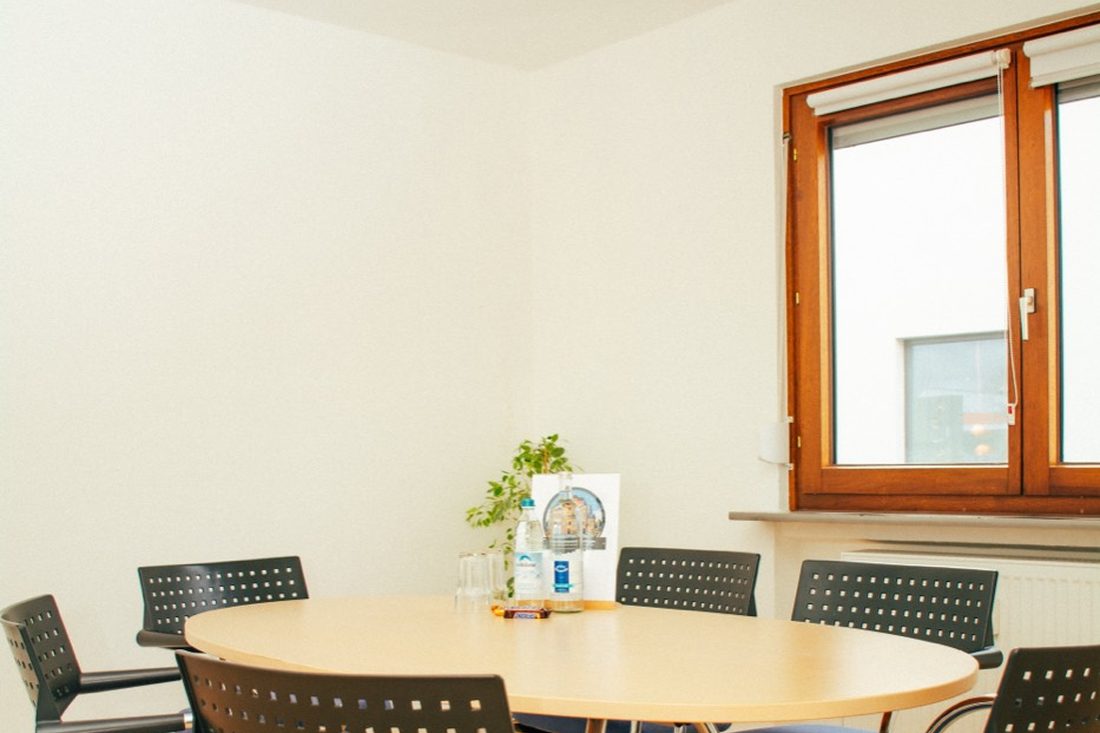
- Rooms in Reutlingen when your people are in the country.
What we do not
- Legal or tax advice. In Germany that is reserved to admitted lawyers and tax advisors, and we introduce you to them instead.
- Nominee directors or shareholders. We will not be, or supply, a stand-in managing director.
- Promise you a bank account, a tax number or a visa. Those are decided by the bank, the tax office and the immigration authority.
- Sell you an address you would not want an official to visit.
Why Reutlingen
Because of where it is. Reutlingen sits in the Stuttgart region, in the middle of the supplier landscape that most Indian companies coming to Germany are actually trying to reach, automotive, machinery, medical technology, precision engineering. Stuttgart airport is forty minutes away, the city is an hour from the A8 corridor, and the customers you want to visit are a drive rather than a flight.
And because a registered office in a mid-sized industrial region reads differently from an address in a building shared with four hundred other companies. When the tax office asks where the business is actually run, having rooms that exist, are used and can be visited is the part that is hard to fake and easy to show.
Questions
Business Center Reutlingen provides administrative and organisational support and introduces you to licensed professionals. We do not give legal or tax advice, in Germany only admitted lawyers (Rechtsanwälte) and tax advisors (Steuerberater) may do so.